What Did Stroyer Not Know About His Family Tree? How Do You Think That Made Him Feel?
This story is our commencement in a series on Black family unit history to celebrate Black history this February.
Growing up in Philadelphia, Amber Jackson said she knew so piddling of her history that she felt disconnected from who she was.
"They didn't teach yous the history of Black people in schoolhouse," she said. "They kind of gave you the illusion that Black people simply showed upwardly after everything was put together."
Attempts to acquire near her family unit history from older relatives were futile, she said. "I could see the hurt in their faces. They didn't desire to talk well-nigh information technology," Jackson said. "So, I let it go."
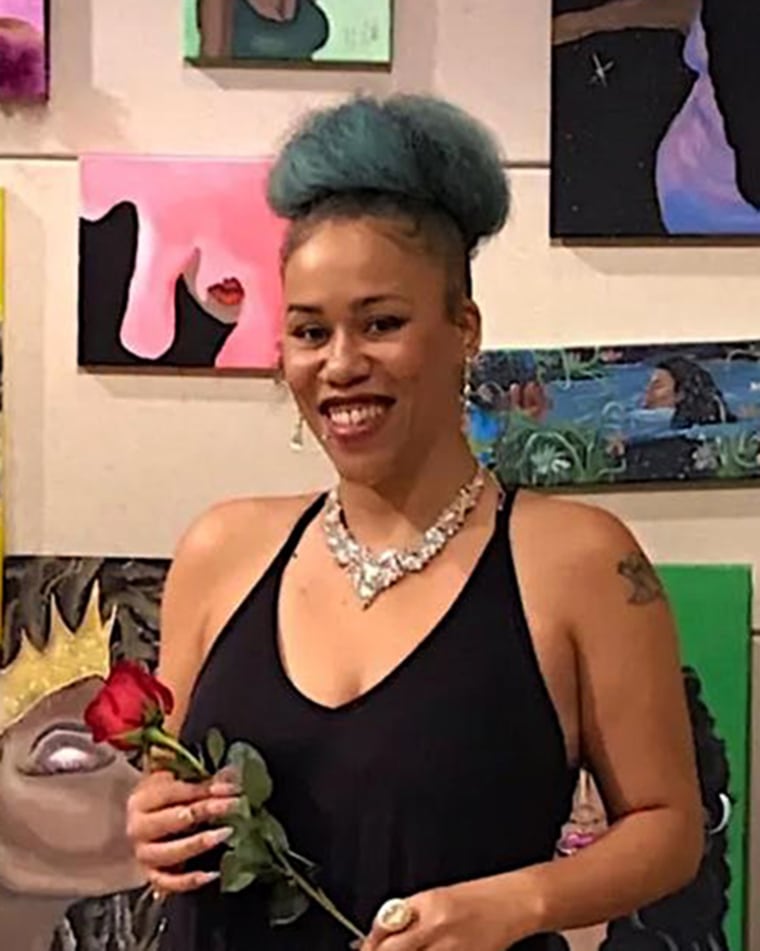
Then she saw the 2002 movie "Antwone Fisher," well-nigh a young sailor who had been in foster care and sought to learn more nigh his birth family. "And that's when I was inspired to commencement my search to discover mine, just like he did," Jackson said.
She said she went through the Whitepages, every bit actor Derrick Luke had in the movie, and located her father'south sis almost instantly and called her, which led to more relatives. The findings inspired her to larn more, and Jackson pressed on, spending hours that turned into years building out her family tree through searching archives in libraries and research centers, scanning microfilm and, every bit applied science advanced, using online services.
In 2021, later on 19 years of probing, she struck Blackness family unit tree gilded: an ancestral connection to the legendary abolitionist Harriet Tubman. Jackson learned that her great-great-grandmother was Jeanette Cornish, whose gramps was Aaron Cornish, built-in in 1822 in Cambridge, Maryland — the same town equally Tubman.
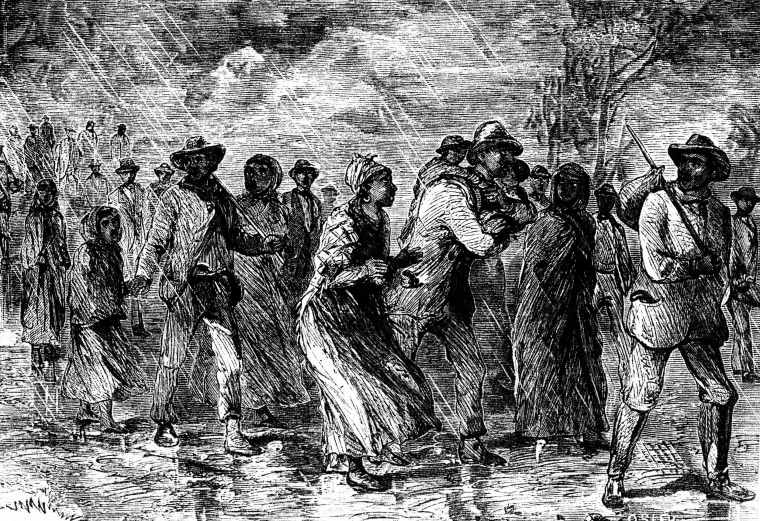
At 17, Aaron Cornish was amidst the 28 enslaved people Tubman led from the plantation on which they were kept. They would after exist called the Cambridge 28, famous for the size of the group that escaped to freedom while conveying weapons to defend themselves, if necessary, and enduring 3 days of torrential rain.
"I watched the Harriet Tubman movie in 3rd grade, and I felt a strong connection, but I didn't know why," Jackson said. "Every year after that, Harriet Tubman was my only focus for my Black History Month reports."
Afterwards confirming the findings, "I cried similar a baby," Jackson said. "Never could I imagine that my great-great-grandparents were freed and attack a path of my generation existence born in Philadelphia because of her."
The revelation elevated her self-esteem, she said, giving her a sense of cocky that had previously been absent-minded.
"First, I felt pride bursting out of every pore," she said. "Then, when I reread their story and what they went through, the emotion changed to an overwhelming hurt and sympathy for my family unit, imagining what my bang-up-grandmother, Daffney, had to endure, giving birth during the escape and having enough organized religion and intestinal fortitude to push forward for non simply her and her husband but her children. I am blown abroad by their strength."
Jackson's story underscores the surge in Blackness people using diverse means to increase their connection to family members who came before them as a way of bolstering their identity. The discovery of bloodlines generates a sense of self that tin exist profound — and tin can fifty-fifty alter how Black people wait at themselves, Jackson said.
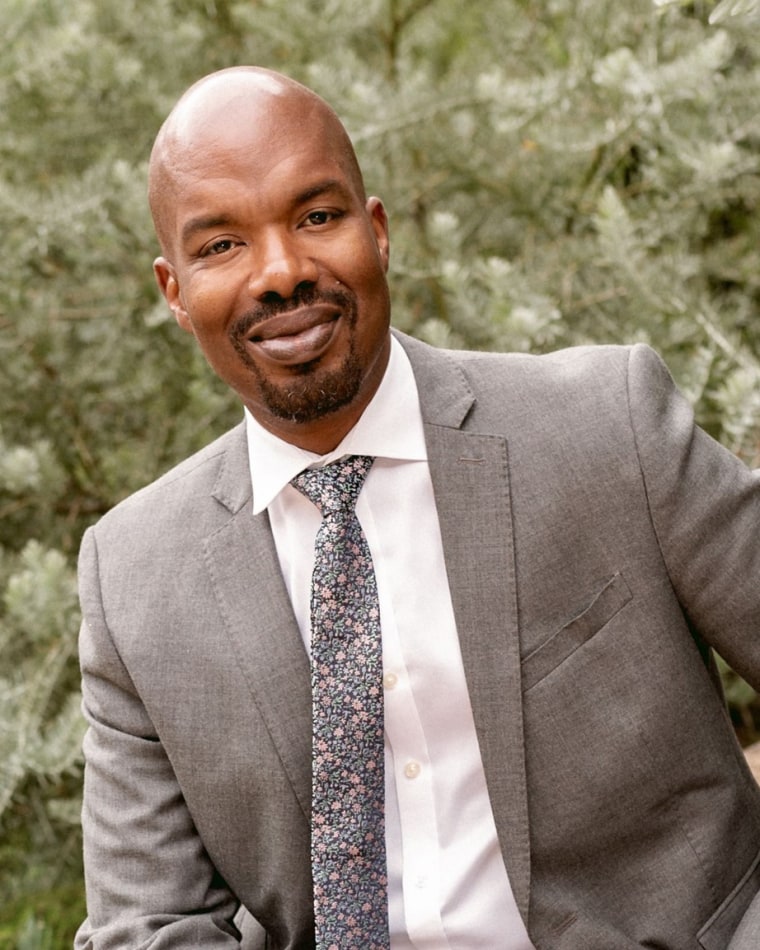
"Remember, Black families were separated purposefully to delete and split any sort of throughline, any sort of emotional connection," said Donald Grant, a clinical psychologist and the executive director of Mindful Preparation Solutions, a consulting firm in Los Angeles that specializes in health and behavioral health. "And and then, considering those things were deliberately severed, a lot of Black people are getting catharsis by identifying these connections that were taken from them. These search options are providing people with opportunities to get tangible examples of their historical resilience. White people have stories nigh their heritage in newspapers and in textbooks that support white superiority and credo. Black people take to find information to build that history, that pride."
'It makes me feel existent. I experience more than human.'
Longtime searchers manually perused records until technology immune for exploring on computers and cellphones. Genealogy websites like Beginnings, 23andme and African Beginnings take proliferated, giving the boilerplate person interested in obtaining at to the lowest degree some bones family unit data access to records.
The increase in Black people searching for relatives is illustrated in the rapid growth of the Facebook folio Our Black Ancestry, which has grown to nearly 36,000 members in seven years. The interest in genealogy has get then prevalent that concluding year Ancestry.com released, gratis of charge, more than 3.5 one thousand thousand records of previously enslaved Black people, documents obtained from Freedman'southward Bureau, a federal agency created in 1865 toward the finish of the Civil War.
For Jackson, that hunger for knowledge turned into an unrelenting appetite to learn more. She said her daily searches that frequently go through the night and into the morning time "give me a sense of belonging, like I didn't just drop out of the sky. I don't think white people wanted us to have a sense of connection to this country. But it'south like, the more I dig, the more people I find and they go real people to me, and I want to know what they did for a living, where they lived. I desire to see pictures of the neighborhoods where they lived. It makes me feel real. I experience more human."
Sharon McKinnis tin can relate to that. A news researcher in the Washington, D.C., area, she said although she was young when she saw the film "Roots," based on the iconic book by Alex Haley, it planted the idea to build her family tree. She sat down with a pen and pad with her grandparents and jotted down data about relatives that had come before them.
"That is a cherished slice of paper," she said. "I notwithstanding have it tucked away in a jewelry box."
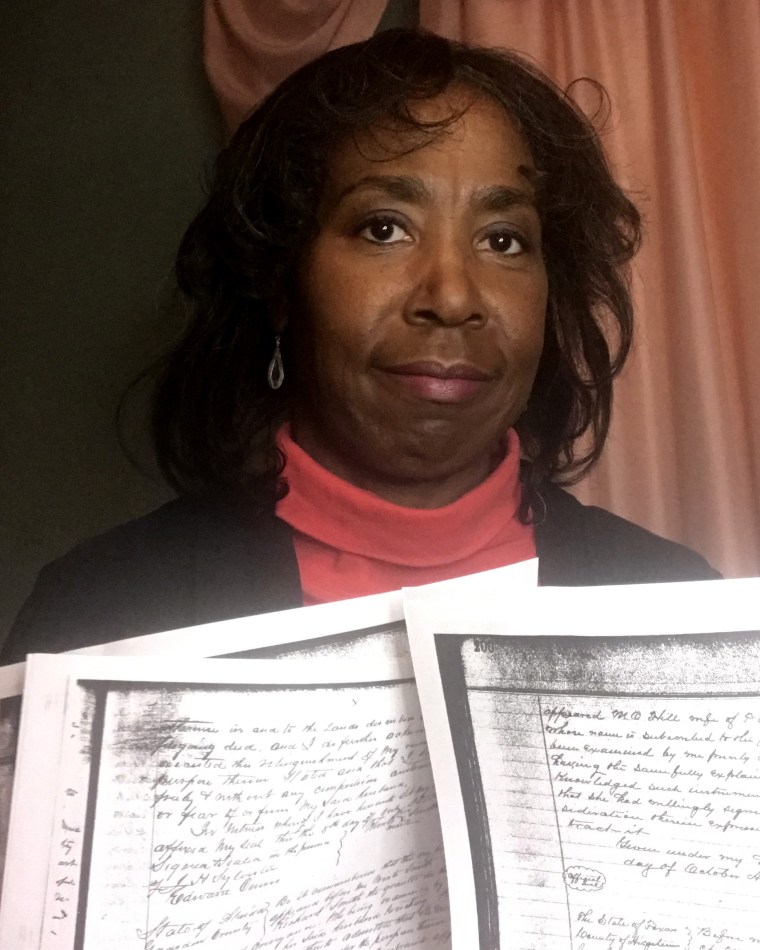
When she got older, McKinnis used it as a guide, and her enquiry revealed that her second dandy-grandmother, Olive Thomas, had been born into slavery only non bars to its ills. In one case slavery ended, she fabricated her own way.
"I found two deeds that she was a office of, and not equally property," she said. "She purchased country from two European women in Florida.
"She was a single adult female, a single mom, and co-ordinate to the demography records, was illiterate. Notwithstanding she was able to earn plenty coin to purchase two pieces of belongings. And I was just like, Oh my gosh. I'm so proud. Information technology makes me experience connected to someone wonderful. I come from a woman who was built-in enslaved, and notwithstanding managed to survive it, number one, and then thrive, despite not having whatsoever didactics. Information technology'south simply wonderful knowing that I come from someone similar that."
Peter Sampson, of Cleveland, sought to find ancestors further back than his grandfather.
He was one of many who were inspired to dig into his family unit tree subsequently the murder of George Floyd in 2020. They contend that the social justice movement spurred on past Floyd's murder magnified the concerns of being Black in America, and therefore inspired them to wait at their past for affirmation.
"We were all suffering after seeing George Floyd get killed like that," Sampson, 56, said. "It was an affront to all Black people. I needed to make a connection to my ancestors for strength. I knew there was something in my family unit — in all Black people's families — that shows our strength. I needed that connection."
Filling in his family tree has empowered him, he said. In two years he has built out his family unit tree to seven generations, he said.
"Information technology's pretty special to accept some true connection to family before you," he said. "I found an uncle who fought in the Civil War; he fought for justice, for liberty. That's something. Information technology's a shame we have to dig like we do to find it. I didn't experience less than earlier I started searching for my family unit. But the reward of learning about them has been about pride and connection that has changed how I experience near who I am."
Jackson and McKinnis are so enthralled and then adept at genealogy that they now help others find their relatives.
"There is and then much power in seeing that family tree abound," McKinnis said. "And I beloved helping people find that history. Some people may say I am obsessed with information technology. I would say information technology'southward my calling. I was put on this globe to find people'south ancestors, to introduce them or reunite them. Information technology takes a lot. There have been lots of times when it hits 2 o'clock in the morning time and I say I am going to log off the calculator and I keep going and now it's 5 o'clock. And then it'southward vii o'clock. Information technology's hard to let go once I latch on to a trail."
That trail, however, can also lead to findings that are not reinforcing, Grant, the psychologist, warned.
"The other side of the searches is that there is 1 group of us who volition be exposed to some traumas when y'all pull up that article showing that your bully-neat-gramps was lynched by a mob in Due south Carolina," he said. "Everybody is not aware of what beingness exposed to that blazon of trauma can do to an individual."
Our genes can tell an even broader story
Genealogists conduct most family searches, but Blackness people can acquire about their family history in a much more specific way by working with geneticists.
The divergence betwixt the ii: Genealogists probe family history through records, articles and other files like deeds, nativity certificates and marriage licenses. Geneticists trace family unit history through Dna, providing a much more precise connection that can lead all the way dorsum to Africa.
Janina Jeff, a geneticist who was the first Black person to graduate from Vanderbilt Academy with a doctorate in human/medical genetics, hosts the podcast "In Those Genes," which investigates issues around commercial genetic ancestry testing and delves deeply into "how far can you become in testing," she said.
"1 of the things I love about these consumer genetic ancestry tests is usa beingness able to find new ways to create community," Jeff said. "Social media has so much value to Black and brown communities because we are able to create communities without barriers. These consumer ancestry tests accept go an extension of that."
Brandon Wilson, a geneticist in Charlotte, North Carolina, said he had not searched his family history notwithstanding merely he planned to do so. For the moment, he is entrenched in inquiry that tin can help Blackness people discover their ties to Africa.
His mentor, Rick Kittles, founded AfricanAncestry.com, which has nerveless DNA samples from tribes across the continent. Clients can then have their DNA compared with that of the tribal populations, "allowing scientists to use the best statistical probability to give you the specific tribe that you're most directly and nigh closely genetically related to," Wilson said. "That gives you a whole different resolution of your African ties.
"So, yous can acquire, for example, that you are of Liberian descent and of a specific tribe in Liberia — and you can request Liberian citizenship."
Generations sharing and exchanging cognition
Ane thing is certain: The mercurial ascent of Black people seeking to learn more about their family history does not seem to be slowing.
"There'southward a growing sense of community pride and community sensation that's being facilitated," Wilson said. "And in that location continues to be a button of generational information sharing that's happening between different generations of our folks who are conscious and aware of the importance of connection. It's actually bridging the gap between generations and taking the veil off a lot of stuff."
Jackson, the Philadelphian who institute family members through the Whitepages, said uniting generations evokes gratification for all involved.
"My dad didn't grow up with his biological father, who was killed when he was a baby," Jackson said. "I found his sister, my aunt, through the telephone book. She knew of my dad but had never met him. Over ii years I plant other members of his dad's side of the family. And when he turned 50, I surprised him and took him to the family reunion of his dad'south side.
"He was like a child, so excited. All the older relatives had heard of him but didn't know how to find him. Being able to find them and connect them with him, seeing the joy that came with those family unit connections for him . . . well, it was priceless."
Follow NBCBLK on Facebook , Twitter and Instagram .
Source: https://www.nbcnews.com/news/nbcblk/family-trees-fill-gaps-black-people-seeking-ancestral-roots-rcna13998
0 Response to "What Did Stroyer Not Know About His Family Tree? How Do You Think That Made Him Feel?"
Post a Comment