Texas Family Code Emotional Development of the Child
This paper presents a comparative analysis of attitudes towards children of parents who take children with disabilities and parents who take children with normal development. Social adaptation of children with disabilities are usually complicated by their emotional groundwork and negative beliefs. Here the author is trying to bring the idea that the features of parents toward the children and their attitudes towards their children have afflicted for the development of the kid. It shows that the features of the touch on of the requirements and expectations of parents to children are non awareness past parents. In nearly cases, it is revealed that parents of children with disabilities practice not desire to perceive adequately opportunities of their children.
Recently at that place has been an increase in the number of children with various special needs, learning disabilities and schoolhouse adaptation, disturbances in emotional-personal sphere and other features.
The birth of a child with disabilities (mental, physical or mental) is a very serious problem for his family. In this regard, often the family unit is going through a astringent crisis, since it is becoming impossible of its beingness in former mode, and it is required a deep restructuring of the entire structure of both inside and outside of the family relationship. The future of the family unit and the kid's future — how he will feel himself: every bit loved and cherished fellow member of the family, and later of a society or every bit an unnecessary burden — depend on successfully overcome of this crunch [one; 52]. Studies on this issue revealed that improper family upbringing leads to bedevilment of the severity of full general mental underdevelopment of a child with special needs. And there are results of a survey which shows that the relations of majority families toward the mentally retarded children is not conducive to their intellectual and social development, parents are frequently inadequately assessed psychophysical capabilities of kid with retardation in development: either overestimate or, conversely, underestimate them. In add-on, parents are prone to excessive paternal care or to ignore the child.
Implementation of the normal life bicycle of the family faces with meaning obstacles, thereby it needs reorganization of family roles. Regardless of the bodily age mental retarded child remains in the office of a young child than really he is, then parents are forced to stay in the function of «nurses». If restructuring in family roles and relationships is fail, there are ii possibilities: the separation the member of the family who breaks habitual life of family unit by territorial disassemble or family breakdown [2; 20]. It is also accompanied with changing in emotional status of parents: emotional alienation from the kid, fear, a abrupt drop in selfesteem, irritability, cocky-incrimination, i.due east. prevalence of destructive feelings about the kid. A. Adler pointed out that the sense of his ain impotence psychological or social, guilt, etc., all these about the compensation of inferiority complex. Very often the parents of children with disabilities demonstrate overcompensation behavior concerning to the child.
M.Chiliad. Semago, N.Y. Semago formulate two types of issues that must be decided past psychologists in this state of affairs.
The outset type includes the cosmos of psychological weather condition for adequate perception past parents the information related to the special features of evolution of the child, psychological readiness for longterm work on development of children with special needs, correction and education of them.
The 2d question is related with the exemption of parents from guilt and the necessity to overcome the stress state of the family, including maternal depression, creating and maintaining every bit much as possible the normal climate in the family unit [3; 56].
Social accommodation of children with disabilities, for the most part, the harmful effects of their feelings and beliefs. These anomalies are due to early diagnosis and treatment in the special institutions, defects of education in their families and social recession. Misbehavior of the children with disabilities is also due to the organic weakening of the nervous arrangement [four; 26, v; 13, 6; 892].
Negative result e'er brings to concerns, anxiety, forms pathological features in the person — one becomes an introvert, passive, doesn't participate in activities, assaults or, on the reverse, shows his all-time, curry favour with the adults or those who is stronger . This gives the way to obedience, obscenity, angriness.
In such families adverse child's stage of development and all sorts of defects in him/her requires psychotherapy work of spoken communication pathologist (or psychologist) [7; 101].
Family do not always understand the personal qualities of their children, too; they either appreciate the child too high,or don't appreciate at all. And mostly the kid'south ability is not fully estimated. Some parents don't believe in the results of this treatment and educational activity. If some of them do non desire to follow the instructions, others practise not have the ability to work. There are too parents who would like to work with the child, and they accept possibilities, but they really practice non know what to first with and how to practice it properly [8; 36].
In this regard, the goal of our piece of work is to compare relationship in the families between the parents and their children with disabilities and relationship between the parents and children in normal families.
This empirical research on the to a higher place given data was nerveless. In the study of parents of children with disabilities nosotros have used «Parents relation inquirer» and PARI — parental mental attitude research instrument.
«Parents relation inquirer» is divers as a organization of different feelings of adults towards the children. This technique is aimed at a comprehensive written report of parental attitudes, the relations of parents to different sides of family life (family roles). The methodology allocated 23-dimension feature on different sides of parent's relations to the child and family life. At that place are 8 signs of describing the attitude to the role of the family and 15 relate to the parent-child relationship. These 15 signs are divided into the post-obit iii groups: ane — optimal emotional contact, two — excessive emotional distance with the child, 3 — excessive focus on the child.
Psychological approach to the parents ratio is kind of pedagogical and social instruction for the parents that includes rational and emotional components. It includes five points that clarify parents ratio various aspects:
- The acceptance-rejection of a child. This indicator determines if they are positive or negative to the child.
- Here, the adults try to consolidate their true interests of the child, they try to sympathize his life .
- The adults endeavour to integrate the child's life or vice versa, try to keep the psychological distance betwixt the child and the adults.
- This indicator shows how adults control the children, how democratic or disciplinarian they are.
- Failures in child's This indicator shows adults'attitude towards the child's abilities, property, illness, shortage, lack of success.
Psychologically, the parent admission for its rational, emotional behaviour components that implements educational and social orientation.
In accordance with the purpose of inquiry, we have formed the report samples. It includes the twoscore men and xl women. The primary criterion for sampling was the presence of children aged 6 to 10 years in a married couple. We have formed four samples: the first sample consisted of mothers of children with disabilities; 2nd sample is fathers of children with disabilities; the tertiary consisted of mothers of children with normal development; and fourth sample — a fathers of children with normal evolution.
The results are illustrated in the following effigy.
According to the effigy we tin reveal that mothers of the children with disabilities, acceptance-rejection scale scored an average of fifteen points. It means that in this group of tested children there are two-sided feelings about their children. That is, on the one hand,they accept into account the individuality of the child, they accept him every bit it is, on the other paw, they experience angry ,because they are not fully confident in the time to come of the kid.
Next, the calibration of cooperation. According to the answers of the tested mums average value of iii points is reached. This ways that these mothers of the children with disabilities experience really upset because they can't perform the part of a proficient teacher.
Six scores the calibration of symbiosis. Information technology's high degree.Which means that mothers and children can not handle the psychological distance between themselves and always wanted to exist shut to the child, are e'er set up to exist a defense in a failure, to bear out basic needs.
Supervision scale got 6 points, which is proved past the higher up shown scale become the object of high level of demand, in lodge to protect the kid, demanding strict obedience, it has been excessively authoritarian.
The scale of the failures of the Child shows a high level of mothers of children with disabilities, that is 7 points. They protect the kid with all their heed, and therefore the kid'due south interests, addicts, thoughts, feelings, are not superfluous for them.
The following assay of the No. 2 refers to a grouping of fathers of children with disabilities that answered the given questionnaire of this methodology.
Acceptance-rejection scale of the child was 8 points. It's a depression level. This means that adults are of negative feelings towards the child.. They are hurt, anger, disappointments, etc. This means these children won't be successful, they don't have future.
Cooperation scale shows 5 points, information technology's an boilerplate level. That is, on the one hand, they are confident in the child's abilities, on the other paw, they seem not to hope for the future.
The highest score of seven on a calibration of symbiosis group indicates that the group of adults can't build psychological distance with the children.
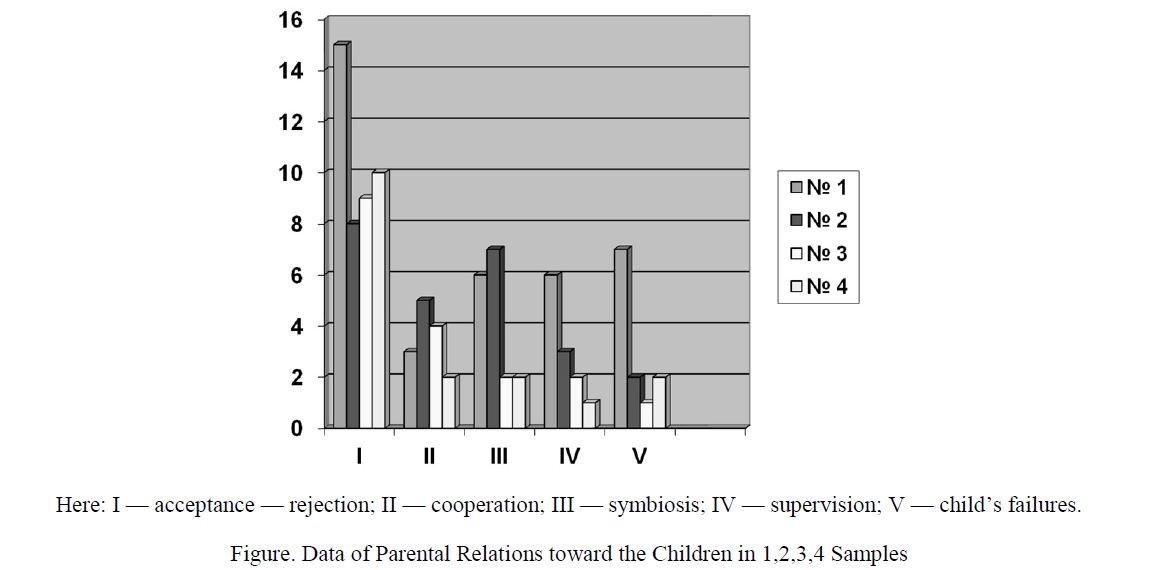
Figure. Data of Parental Relations toward the Children in 1,2,3,iv Samples
And supervision of the fathers of children with disabilities scale shows iii points, the average level.
In his relationship with a kid under certain circumstances he makes the kid do what he demands, that is becomes authoritarian; in some cases,when needed father lets the child behave on his own.
Failures to decide the relationship of the child scale is 2 points but. It'due south low level. They merits their son's failure was accidental, which contravenes the data on the scales higher up. This is contradictory because on the i hand, the child's disability don't give father hope, on the other hand,the adult nonetheless has promise that the situation might alter in the hereafter.
No. 3 Select — mothers of normal children. No. iv Select shows fathers of the normal or unlimited opportunities children.
Acceptance — rejection scales No. 3 No. 4 bear witness 9 points and ten points .That'due south a medium level. This means that parents recognize the individuality of the children on the one manus, on the other hand, in some cases, they have expressed lack of confidence.
Cooperation calibration tells that mothers are on the medium level, while fathers express low level which means that they are reluctant to be on an equal relationship terms.
Symbiosis calibration .Both mothers and fathers show depression level, two points only. In other words, there'south a pregnant psychological remote betwixt the kid and adult.The parents are not very much interested in the needs of the children.
Calibration of supervision examination gives the same low level as before. This is uniform with the above scale information declares about a lack of supervision in respect of a child by an adult.
My failures calibration group of mothers and fathers once more show depression-level. They think their children's failures happen accidentally; they believe nothing of this kind happens in futurity.
To review the results of this approach, there are meaning differences between each tested grouping: group i and 3, group 1 and 4, group 2 and group 4, 3 and 4. Now the parents of children with disabilities and the normal children's parents, when compared to the values in betwixt, it is non superfluous to say that they have a high level of differences.
Further results obtained by the second method does non contradict the data that appeared earlier. First of all it should exist noted that mothers of children with disabilities is strongly depend on the family unit, on the other words, the vital interests of these women are express to the domestic sphere and family needs. Then in this group of women information technology is tended to limited high level of sense of sacrifice. They are characterized by the perception of family conflict equally a normal phenomenon of life. In their opinion the authorization of parents in the family must be absolute, that mean if they are sacrificing themselves for family needs, they crave for that absolute obedience from the kid. It is obvious that mothers of children with disabilities and so recoup the frustration of his life situation. In the majority most of them are not satisfied with the back up of their husbands in this situation and feel lonely.
With regard to children the subjects in this sample show that children must attach to a passive role in the family. So every bit a issue they do not make an effort for the development of children's activity. Indicator of emotional distance towards children in this grouping have medium level. This suggests that for mothers emotional communication with ain children is not every bit relevant. Merely despite of this they are besides march focused on the child.
Mothers of children with disabilities practise non want children to grow up to fast. Probably it is due to the fact that deep down they are afraid of the time to come of their child.
Fathers of children with disabilities are besides denied their needs for the sake of the family. I.e. the interests of the family are placed above individual. Every bit mothers fathers also are characterized by cede, the perception of their kid as a passive and feeble person. While nearly of the child intendance they shift to mothers. At the same time they are non satisfied with the own status and their place which occupy in the family. They are characterized by strategy of fugitive problem, astute situations. Still the fathers compeering with mothers are want to their children have grown upwardly quickly. An additional it tin be said that the subjects in this grouping testify tough style of parenting.
In the control group neither mothers nor fathers of ordinarily developing children are not inclined to cede themselves for the sake of the family. Fathers take a more authoritative parenting style here. In contrast to the parents of children with disabilities, this group of parents are not overly concentrated on the child.
Thus, the parents of the children with disabilities are more than strict to their children and expect the children to do what they say in comparison with the parents of normal children.
Parents of children with disabilities desire them to be dependent on the parents. The parents of normal children give freedom to their children to a certain extent.
Most parents believe it is important to be authoritative.
Mothers of the children with inability think that they are solitary with their problems (to grow and bring upwardly their children) and they are agape of their children's growth. On the reverse fathers want their children to grow faster.
In comparison with fathers mothers do not like the idea of growing, developing and becoming independent of their children.
In most cases, the parents of the children with disabilities tend to pass up his/her real land.
Then parents of children with disabilities are not realize that their children could be on their ain. Therefore they more watch over and make their children dependence from parents. This is achieved by an disciplinarian fashion of interaction with the child.
Mothers of children with disabilities accept more than fearfulness about the future life of their child than fathers.
Because of this, they do not want their children to grow up very quickly.
All parents are feel that they should be respected and crave children to be submitted to them.
They overly inflate the abilities of the child and demand the child likewise high tasks that do not see the requirements. This ways that the parents do not realize what impact occurs.
Список литературы
- Семья в психологической консультации: Опыт и проблемы психологического консультирования / Под ред. А.А. Бодалева, В.В. Столина / Науч.-исслед. ин-т общ. и пед. психологии АПН СССР. — М.: Педагогика, 1989. — 208 с.
- Юртайкин В.В., Комарова О.Г. Семья и ребенок с особыми нуждами // Школа здоровья. — — № i. — C. 17–25.
- Семаго Н.Я., Семаго М.М. Проблемные дети: Основы диагностической и коррекционной работы психолога. — М.: АРКТИ, 2001. — 203 с.
- Бреслав Г.М. Эмоциональные особенности формирования личности в детстве: норма и отклонения. — М.: Педагогика, 1990. — 144 с.
- Валлон А. Психическое развитие ребенка. — СПб.: Питер, 2000. — 224 с.
- Выготский Л.С. Вопросы детской психологии // Психология. Избранные психологические труды. — М.: Изд-во ЭКСМО-Пресс, 2000. — С. 892–987.
- Коррекционная педагогика: основы обучения и воспитания детей с отклонениями в развитии: Учеб. пособие. — М.: Аcademia, 2001. — 157 с.
- Петрова В.Г., Белякова И.В. Кто они, дети с отклонениями в развитии? — М.: Флинта: Моск. психолого-социальный ин-т, 1998. — 104 с.
Source: https://articlekz.com/en/article/14234
0 Response to "Texas Family Code Emotional Development of the Child"
Post a Comment